User Manual On A Chevy Tracker
- Is There A Aux Fuse On A Chevy Tracker
- User Manual On A Chevy Tracker Repair
- How To Change The Starter On A Chevy Tracker
Yearly Updates 1991 Tracker Suzuki had offered rear-drive and 4WD versions from the start. This year, Geo added the 2-wheel-drive convertible, available only with 5-speed manual shift. All Trackers added antilocking for their rear drum brakes. Standard 4WD and base convertibles got new black bumpers, door handles, and bodyside moldings.
Base models kept manual hubs, but LSi Trackers got automatic-locking hubs. 1992 Tracker Tilt steering wheel was a new option, and dashboards looked a little different. 1993 Tracker Except for new colors and revised radio controls, Trackers again showed nearly no change. 1994 Tracker California Trackers got a different engine: a 95-horsepower rendition with four valves per cylinder.
1995 Tracker All 4-wheel-drive Trackers adopted the 95-horsepower engine. 1996 Tracker All Trackers added dual airbags and a 4-door wagon was available for the first time. The 4-door measured 11 inches longer in wheelbase and 15 inches longer overall than the convertible. Trackers also had a revised front-end look and new wheels.
Three-door hardtop bodies were gone. New options included 4-wheel antilock braking, which worked in both 2- and 4-wheel drive. 1997 Tracker The upscale 2-door LSi convertible was dropped for ’97. Meanwhile, the base ragtop gained a folding rear bend seat as standard equipment.
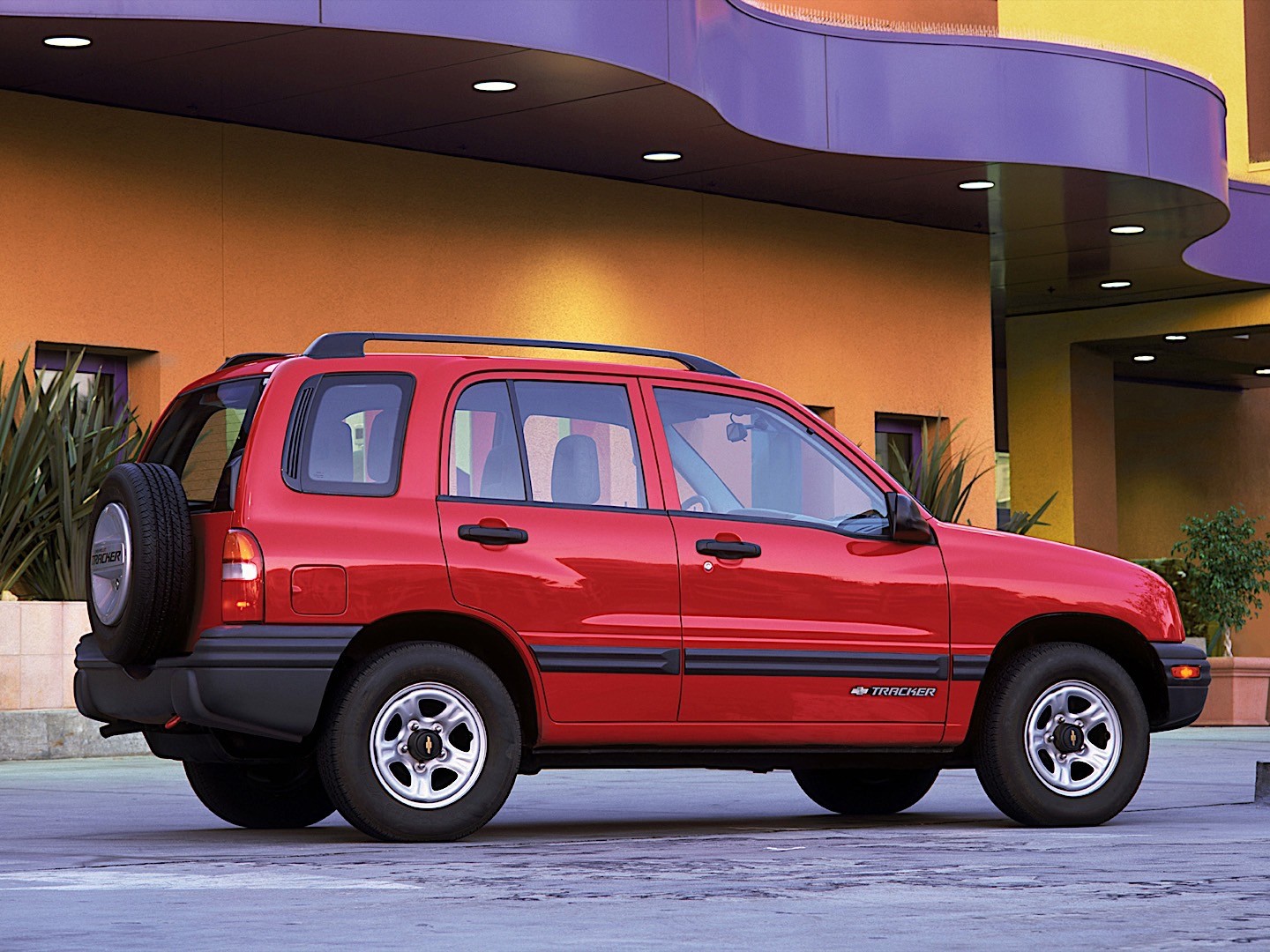
1998 Tracker Tracker puts on a Chevy bow tie badge and loses its top LSi trim level for 1998. Other changes are minimal. An all-new Tracker, again under the Chevrolet name, was waiting for ’99. Every Tracker holds a 1.6-liter overhead-cam 4-cylinder engine, which started at 80 horsepower. A more potent version, with four valves per cylinder and rated at 95 horsepower, went into California Trackers in 1994, all 4-wheel drives in ’95, and all models the next year.

Is There A Aux Fuse On A Chevy Tracker
A 5-speed manual gearbox was standard; 3-speed automatic transmission optional. On-demand, part-time 4-wheel drive went into all Trackers at first, with a floor-mounted transfer case. Manual-locking front hubs have to be adjusted by hand from outside the vehicle before 4-wheel drive can be engaged. LSi Trackers adopted automatic-locking hubs in 1991. A new 4-speed automatic transmission was available for the 5-door wagon in ’96. The initial 80-horsepower engine has sufficient power for decent acceleration and passing on the 2-door model. With automatic, you have to push the pedal to the floor often to keep up with traffic.
That’s true even with the 95-horsepower engine. In addition, four-doors are so sluggish with automatic that passing maneuvers have to be planned with care. Gas mileage is fine.
User Manual On A Chevy Tracker Repair
We’ve averaged 24 mpg in a 4-wheel-drive convertible and 28.6 mpg with 2-wheel drive. Tall and narrow, a Tracker must be driven with care through turns due to a high center of gravity. Even if it’s not quite as precarious as it may seem while cornering, the abundant body lean quickly grows frightening. The ride is undeniably choppy, and noise levels are high.
How To Change The Starter On A Chevy Tracker
Two-wheel-drive Trackers are softer suspended for easier going on rough pavement, but even they get choppy. A Tracker’s interior is roomy for two in front, but the back seat is best for children. The driver’s seat lacks much rearward travel, and suffers minimal space past one’s left shoulder. Cargo space behind the rear seat is minuscule, but at least you can fold the seat forward if a load of parcels has to be transported. Controls operate smoothly; gauges are simple. Four-door wagons offer lots of head room, adequate rear leg space, and ample cargo area. Trouble Spots Automatic transmission Description: Automatic transmission hunting may be caused by a torque converter clutch that applies and releases too rapidly.
(1990-95) Automatic transmission Description: The Hydramatic (3L30) automatic transmission causes bucking and jerking due to a problem with the torque converter applying and releasing if the carmaker’s modification kit is not installed. (1990-95) Engine misfire Description: The PCV breather hose may freeze up while driving in cold weather causing a loss of oil and engine damage. (1990) Exhaust system Description: The two-piece muffler/tailpipe may rust out prematurely. If the tailpipe rusts through, heat can damage the rear floor and carpet. GM will install a heat shield over the exhaust system. (1990-91) Keys Description: The original keys were made with a soft metal compound that causes them to break. (1990) Manual transmission Description: Because of the rubber compound used to make the shifter boots, some vehicles may not go into four-wheel drive or they may pop out of 4WD.
The boot will be replaced with one having softer rubber, at no charge. (1995) Accessory belt Description: Power steering pump bracket may cause serpentine belt to fray or break on 2.0-liter engine. Revised part is available.